Anabolic Solider
The military's new testosterone screening policy, read through a clinical lens.

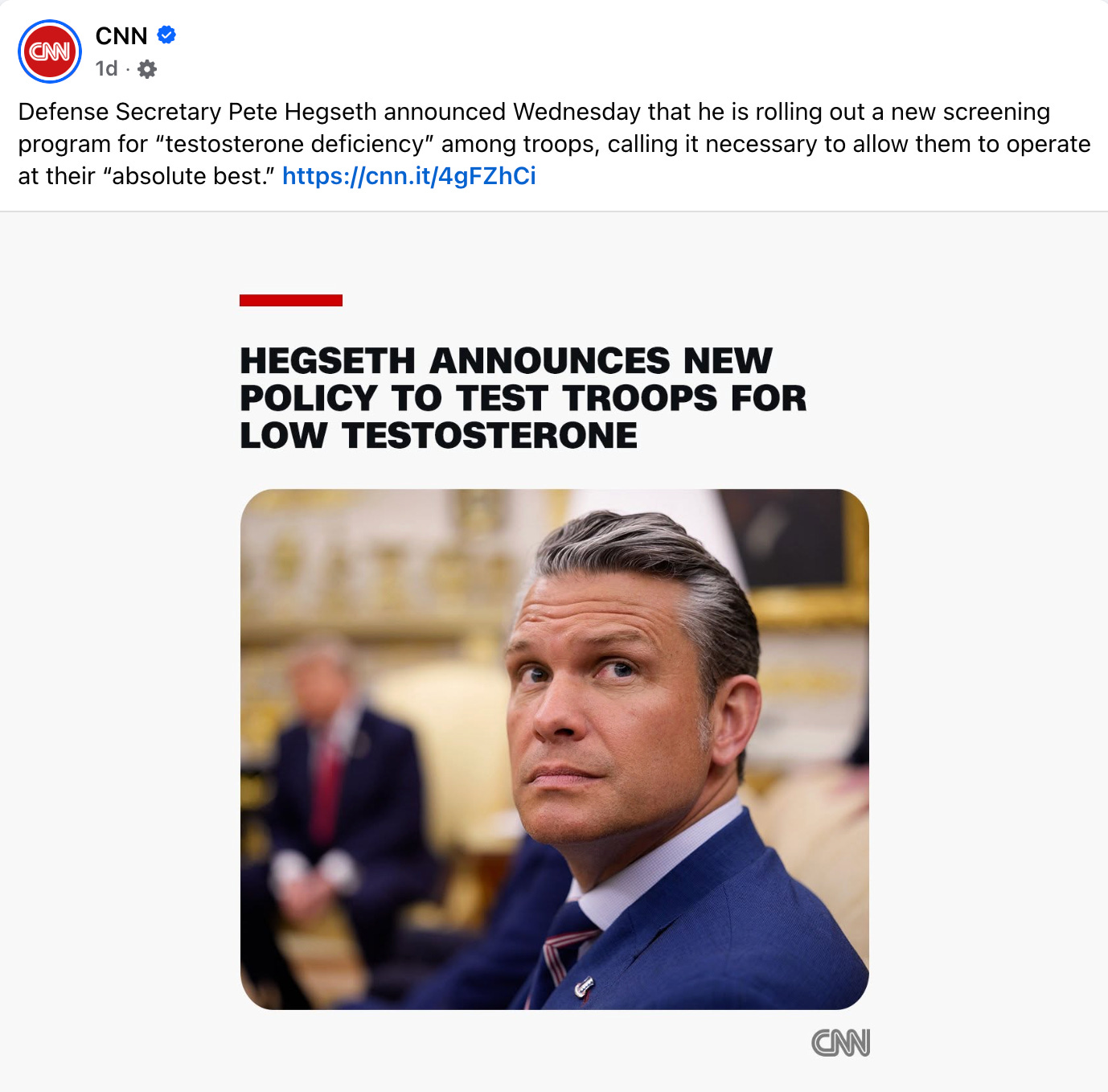
Secretary of Defense Pete Hegseth announced last week that the US military will begin annual testosterone screening for service members over 30, with voluntary screening available for younger troops and testosterone replacement therapy offered to those who meet criteria.
The political reaction has been predictable: split along the usual axes, and mostly beside the point. The clinical questions the policy actually raises are more interesting and worth taking seriously on their own terms, because they cut to real problems in how testosterone is being managed in medicine right now.
This is worth walking through carefully - the policy could have genuine clinical merit, and also real clinical risks. Which of those dominates over the next few years depends almost entirely on how the screening thresholds, the prescribing criteria, and the monitoring standards are implemented.
But make no mistake: testosterone is a vital hormone, and there is a version of this policy that meaningfully improves the health of a large population of underserved men.
There is also a version that produces overdiagnosis, overprescription, and a generation of service members on unnecessary hormone therapy.
Why The Underlying Question Is Actually A Good One
Low testosterone is one of the most consistently underdiagnosed conditions in adult male medicine. The generational decline in testosterone levels is well documented (a 60-year-old man in the early 2000s had roughly 17 percent lower total testosterone than a 60-year-old in the late 1980s, per Travison and colleagues in JCEM 2007, and the trend has continued into younger cohorts through the Lokeshwar NHANES analyses). The prevalence of symptomatic clinical hypogonadism in men over 30 is not trivial, and the vast majority of those men are never screened.
Why are they not screened, you may ask?
Primary care does not routinely check testosterone, as symptoms can feel nebulous and abstract, and men who do get diagnosed often find their way there through a gray-market telehealth clinic rather than through structured medicine.
Against that background, screening men over 30 in a population with particularly high physical, cognitive, and stress demands is defensible. Military service members face chronic sleep deprivation, sustained caloric strain, high stress, and physical demands that all suppress testosterone independently. Many of them are quietly suboptimal for hormonal reasons that would be trivial to identify if anyone actually looked. The screening question, in isolation, is a reasonable clinical question.
The specific implementation as described (annual total testosterone as part of the periodic health assessment, with reflex testing for free testosterone and SHBG in men who screen low) is standard endocrinology practice. It is what an internist trained in the right subspecialty would order. The problem, as always with this kind of medicine, is not the screening. It is what happens after the screening.
Where The Clinical Risk Lives
Three specific concerns are worth naming, and each of them cuts to how the policy will actually be implemented over the next two to five years.
The first is the diagnostic threshold problem. Testosterone reference ranges are typically 264 to 916 ng/dL in adult men, but “normal for the reference range” and “adequate for a given individual” are not the same thing, and clinical hypogonadism requires both a low lab value and symptoms consistent with the deficiency. The consensus guidelines from the Endocrine Society and American Urological Association both explicitly require symptomatic presentation plus consistent low labs on two morning draws before diagnosis. If the military policy defaults to treating any lab value below some cutoff regardless of symptoms, or if it uses a cutoff drawn from athletic performance rather than clinical guidelines, the door opens to treating asymptomatic men. That is a real problem, both because the treatment carries real risks and because it medicalizes normal variation.
The second is the reversibility problem. A large fraction of men who present with low testosterone in their 30s and 40s have secondary hypogonadism driven by reversible factors: obesity, insulin resistance, obstructive sleep apnea, chronic sleep deprivation, extreme training loads, opioids, and untreated depression. Treating those men with exogenous testosterone can produce the desired lab and symptom response, but it does not address the underlying pathology, and it commits the patient to lifelong therapy while shutting down their own HPG axis. In a military population with high rates of sleep deprivation and physical stress, a substantial fraction of the men who will screen low would recover their own testosterone production with metabolic restoration and sleep normalization. Whether the screening pathway pushes patients toward that workup first, or straight to a prescription, will determine whether the policy is closer to good preventive medicine or closer to a large-scale iatrogenic problem.
The third is the monitoring problem. Testosterone replacement done well is a chronic disease management program. It requires baseline and follow-up labs including hematocrit (secondary erythrocytosis is the most common serious side effect), lipids, PSA in age-appropriate patients, estradiol, and periodic reassessment of the underlying indication. It requires patient education about fertility effects (exogenous testosterone suppresses spermatogenesis) and about the near-certainty of lifelong therapy once the endogenous axis is suppressed. Whether the military healthcare infrastructure can deliver that level of ongoing management at the scale the policy implies is a real question, and if it cannot, the risk profile changes.
Worth noting: The concerns from Senator Duckworth about parity for female service members are also clinically legitimate. Women have a hormonal aging story too, including the perimenopause and post-menopause transition, and any policy that screens the male hormonal system while ignoring the female one is providing asymmetric care. A comprehensive hormonal screening program for military service members would include both sexes with appropriate protocols for each.
What This Reveals About Civilian Testosterone Medicine
Whatever the policy ultimately produces in the military, it is holding up a mirror to civilian medicine that is worth looking at. Testosterone screening in the general US male population is haphazard, inconsistently implemented, and often gated by insurance criteria that lag the actual clinical evidence. Symptomatic men in their 30s and 40s frequently cannot get their testosterone checked without asking specifically for it, and the primary care threshold for the conversation is often “we’ll check next year.” The gray-market direct-to-consumer TRT industry has filled that gap in the worst possible way, with minimal workup, minimal monitoring, and prescribing driven by wellness marketing rather than by clinical criteria.
The military policy is imperfect but at least explicit - it says the screening should happen, and it commits the health system to acting on the results. That framing, if implemented well, is closer to how testosterone should be handled in general internal medicine than the current civilian standard is. The correct civilian response to this policy is not to argue about whether the military should do it, but to notice that the case for structured testosterone screening and management is stronger than mainstream civilian primary care currently reflects, and to close that gap with better protocols rather than by delegating the problem to online clinics with a subscription revenue model.
This post is for informational purposes and does not constitute medical advice. Any decision to initiate or continue testosterone replacement therapy should be made with a knowledgeable physician based on individual symptoms, labs, and monitoring.
Treating the lab value instead of the person is the trap, and you named it clearly. The question of what happens after the screen is the whole policy.